
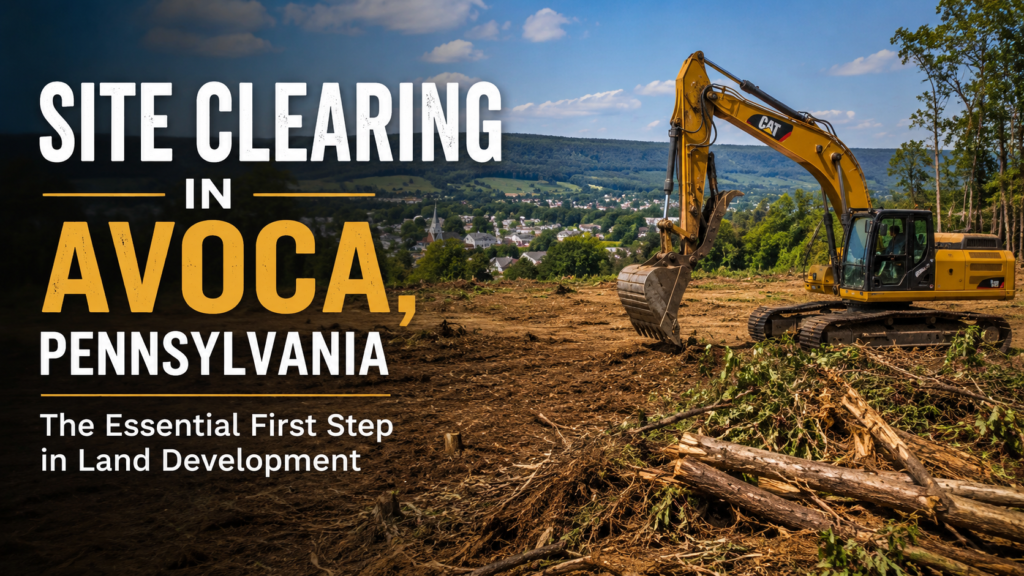
Before any excavation can begin, before any foundation can be poured, and before any pavement can be laid, the land must be cleared. Site clearing is the foundational preparatory operation that transforms raw, vegetated, or obstructed land into a workable surface ready for construction activity. In Avoca, Pennsylvania situated in the Lackawanna-Luzerne County region where former industrial land, established residential neighborhoods, and commercial corridors all present varied site conditions Site Clearing Avoca is a specialized service that requires equipment, planning, and environmental awareness appropriate to each project’s specific context.
What Site Clearing Involves
Site clearing encompasses the removal of all vegetation, surface obstructions, and debris from the proposed development footprint. Depending on the site condition, this can include:
- Tree removal: Felling, limbing, and removal of trees within the clearing footprint. For larger trees, this may involve cranes or high-reach equipment in addition to chainsaws and chippers.
- Brush and shrub clearing: Dense understory vegetation is typically cleared with forestry mulchers, brush cutters, or bulldozer blades, depending on density and terrain.
- Stump grinding or removal: After trees are felled, stumps must be addressed. Stump grinders reduce stumps to below grade level without full excavation; excavators can extract entire root balls where complete removal is required.
- Herbaceous vegetation stripping: Grasses, weeds, and low ground cover are stripped with a blade during the initial topsoil stripping operation.
- Debris removal: On previously developed or long-vacant sites in the Avoca area, surface debris dumped materials, construction waste, and accumulated litter must be removed as part of the clearing scope.
- Topsoil stripping and stockpiling: The biologically active topsoil layer is stripped separately and stockpiled for redistribution during fine grading, preserving this valuable resource rather than burying it in fill operations.
Site Clearing in the Context of Avoca’s Development History
Avoca and the surrounding Lackawanna-Luzerne region carry a distinctive development history shaped by the anthracite coal industry that dominated the area through much of the nineteenth and twentieth centuries. Properties in and around Avoca may sit on or adjacent to former mining operations, coal refuse areas, or industrial sites that introduce specific site clearing considerations beyond standard residential or commercial development.
Former industrial sites may contain buried infrastructure old pipe, electrical conduit, building foundations, and miscellaneous hardware that is not visible at the surface but that poses safety and operational risks during clearing and excavation. Pennsylvania’s One Call (811) system requires notification at least three business days before any ground disturbance, so that utility companies can mark active underground lines. Even on sites where no active utilities are expected, notification is legally required and practically essential.
Pennsylvania Environmental Regulations Affecting Site Clearing
Site clearing in Pennsylvania is governed by several environmental regulations that apply to different aspects of the work:
- Pennsylvania’s Soil Erosion and Sedimentation Pollution Control Act (Act 167): Requires an erosion and sediment control plan for any earth disturbance activity on 5,000 square feet or more of land in Pennsylvania. Projects disturbing one or more acres require a National Pollutant Discharge Elimination System (NPDES) permit.
- Stormwater management requirements: Clearing operations that will alter drainage patterns may require stormwater management planning under Pennsylvania DEP regulations.
- Clean Streams Law compliance: Any earth disturbance that has the potential to discharge sediment to streams, wetlands, or other waters of the Commonwealth requires appropriate erosion control measures and may require coordination with the Pennsylvania Department of Environmental Protection.
- Timber harvesting regulations: If significant timber is being removed during site clearing, Pennsylvania’s timber harvesting best practices apply.
Experienced site clearing contractors in the Avoca area are familiar with these regulatory requirements and build compliance planning into the project scope from the outset.
Equipment Used in Site Clearing Operations
The equipment deployed for site clearing in Avoca depends on the site size, vegetation density, and site access conditions:
- Forestry mulchers: Track-mounted or skid steer-mounted rotary drum mulchers that grind trees, brush, and stumps into small chips in a single pass. Highly efficient for brush and smaller tree clearing, and leave no debris to haul away.
- Excavators: Versatile machines used for stump extraction, debris removal, and demolition of small structures within the clearing footprint.
- Bulldozers: Used for large-scale pushover clearing of trees and brush on open sites with adequate access. Produce windrows of material that must be chipped or hauled.
- Skid steer loaders: Highly maneuverable in confined spaces; useful for material loading, debris cleanup, and operating various clearing attachments.
- Chippers and grinders: Convert cleared material into chips for on-site composting, mulching, or as a reusable ground cover material.
- Dump trucks: Required to haul material that cannot be processed on-site.
Protecting the Site During and After Clearing
Once vegetation is removed and topsoil is stripped, the exposed soil surface is immediately vulnerable to erosion. In Pennsylvania, where clearing is frequently followed by periods of rain before construction begins, erosion control measures must be deployed as clearing proceeds:
- Silt fence installation along site boundaries, particularly downslope and at drainage channels.
- Temporary seeding of areas that will remain exposed for more than 14 days.
- Stockpile protection silt fencing and temporary seeding of topsoil and fill stockpiles.
- Stabilized construction entrances to prevent mud tracking onto adjacent public roads.
Pennsylvania’s erosion and sediment control regulations require that these measures be in place before ground disturbance and maintained throughout the project. Inspections after rain events and prompt repair of any control failures are part of responsible site clearing practice.
The Connection Between Site Clearing and Subsequent Construction Phases
Site clearing is not an end in itself it is the enabling first step of a construction sequence. The quality and thoroughness of the clearing operation directly affects how efficiently subsequent operations proceed. A thoroughly cleared and properly prepared site allows grading equipment to work without obstruction, drainage systems to be installed in accurately located positions, and building layout to be established on a clean, unobstructed surface.
Sites that are cleared carelessly with stumps left in the ground, debris pushed just below the surface, or topsoil buried rather than stockpiled create problems that compound through every subsequent construction phase. The extra time and cost of thorough site clearing upfront is recovered many times over in the efficiency and quality of the construction that follows.
Conclusion
Site clearing in Avoca, Pennsylvania is the first, foundational act of every land development project. From the residential lot being prepared for a new driveway to the commercial parcel being cleared for a new building, the principles of thorough clearing, responsible erosion control, and environmental compliance are consistent. Property owners and developers in the Lackawanna-Luzerne area who begin their projects with properly executed site clearing build on a foundation that supports the success of everything that follows.